

I safely landed on Yakushima a few days ago and am having some time to reflect on my time in Kyoto and Tokyo last week. Serendipity is such an interesting magic. Ever since I was introduced to the world of 「草木染め」 - the art of natural plant-dye - my world seems to evolve around it. Thinking way, way back, my first encounter with the plant-dye world was back in 2012, here on Yakushima island, when I had a chance to stop by “Studio Copal”, which no longer exists. I purchased a few embroidery threads dyed with plant dyes. I didn’t know why at the time, but I kept them in my treasure box as if they were made of gold. After returning to the island this time, I was talking to my dad about my recent interests in the art of plant-dye, and he happily brought out all the books he kept from emptying the house I am currently staying in when he purchased the house from the previous owner a few years ago (with most of her belongings still left in the house due to circumstances). As he organized the house to prepare to rent it as an Airbnb, he decided to keep the collection of plant-dye-related books she left behind. As he brought over a stack of books from his bookshelf, I started flipping through them. The collection of books was impressive. Some books were from the 1940’s, written by a plant-dye specialist who studied and practiced the Japanese art of plant dyeing.
This story’s introduction is to say that I had an amazing visit to Haru-chan’s atelier (haru nomura) in Kyoto last week. Early March in Kyoto was still very cold, especially up in the mountains where her atelier was. I bundled up as many layers as I could and stepped on an hour-long local bus on the winding road along the creek up the mountain. This was my second time visiting Haru-chan (story about my first visit here), and I was hoping to get to know her deeper and hear more about her approach to plant dyes, art, and designs. Luckily, Kei just returned from her home in Chicago, so Kei and I (both slightly jet-lagged) rang Haru-chan’s doorbell together.


Ichigo Ichie with sakura mochi since the fresh ones are only available during the cherry blossom season.
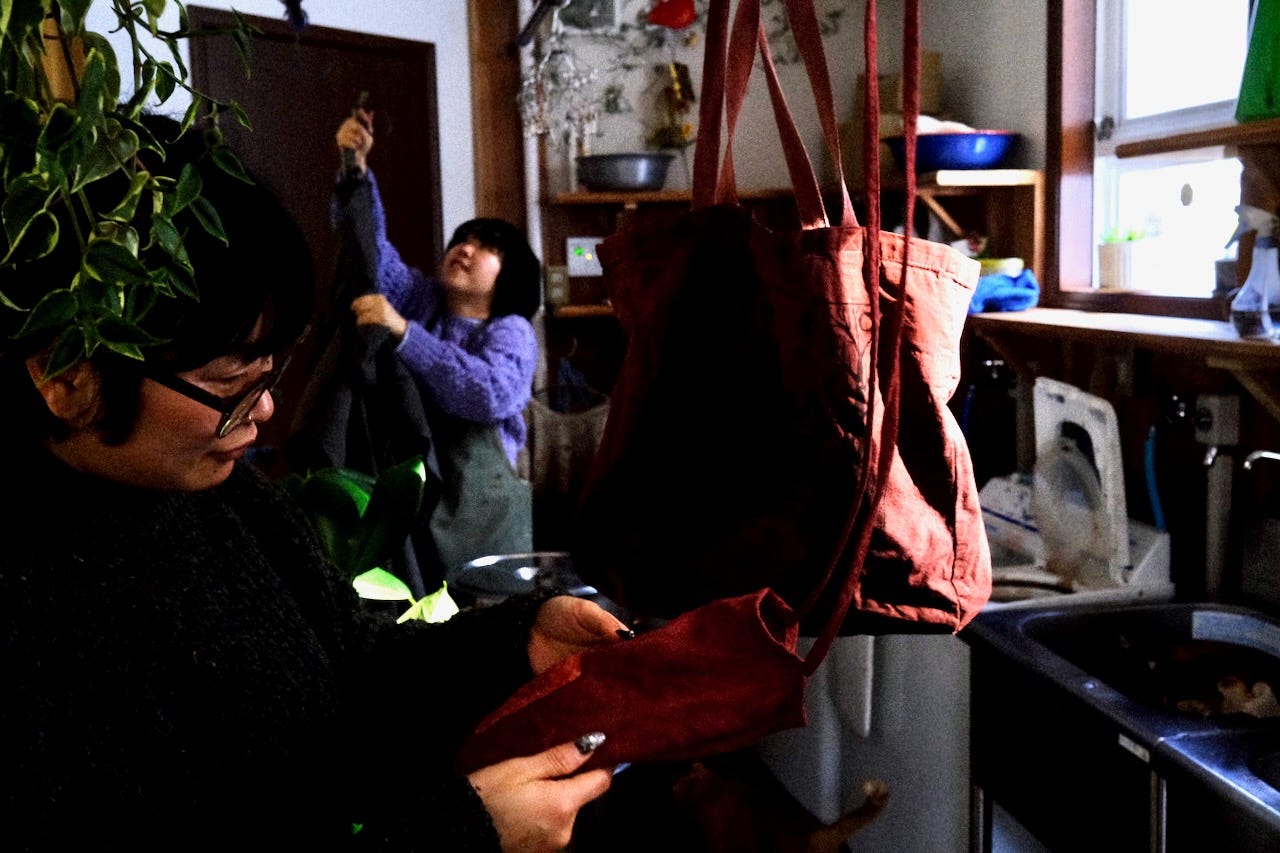
I am so grateful Haru-chan suggested we try hands-on plant dyeing with her during our visit. I had my Pocket Bag, which she previously dyed with Logwood back in 2023. Since it had been a while, the purple had slightly faded, making it a perfect base to layer another color. To be able to take part in dying a bag (even though the process was a tip of the iceberg of what Haru-chan does professionally) was really inspiring. Probably my favorite part was mixing a huge pot full of dried and crushed Indian Red Madder mixed in the boiling water. With a long stick in my hand, mixing the portion, and inhaling the aroma of Red Madder reminded me of a witch bending over her magical cauldron.


Haru-chan holding the bags Kei and I re-dyed with Red Madder.
Red Madder layered over Logwood Purple holds different color vibrations compared to the straight Red Madder dye. I love how it’s a little deeper and moodier. I was curious why I so gravitate towards the fragrance of Red Madder dye. Haru-chan explained to me that Red Madder historically has also been used as a medicinal herb. Strangely (but perhaps not that strangely), it’s the smell that stirs deep memory within me.
While we waited for the freshly dyed bags to air-dry (Kei also re-dyed a bag she brought in Red Madder), Haru-chan suggested we could paint on washi paper with the dye we just made. Since I bind notebooks using plant-dye paper, I was especially excited to see how these colors would bloom on the washi.


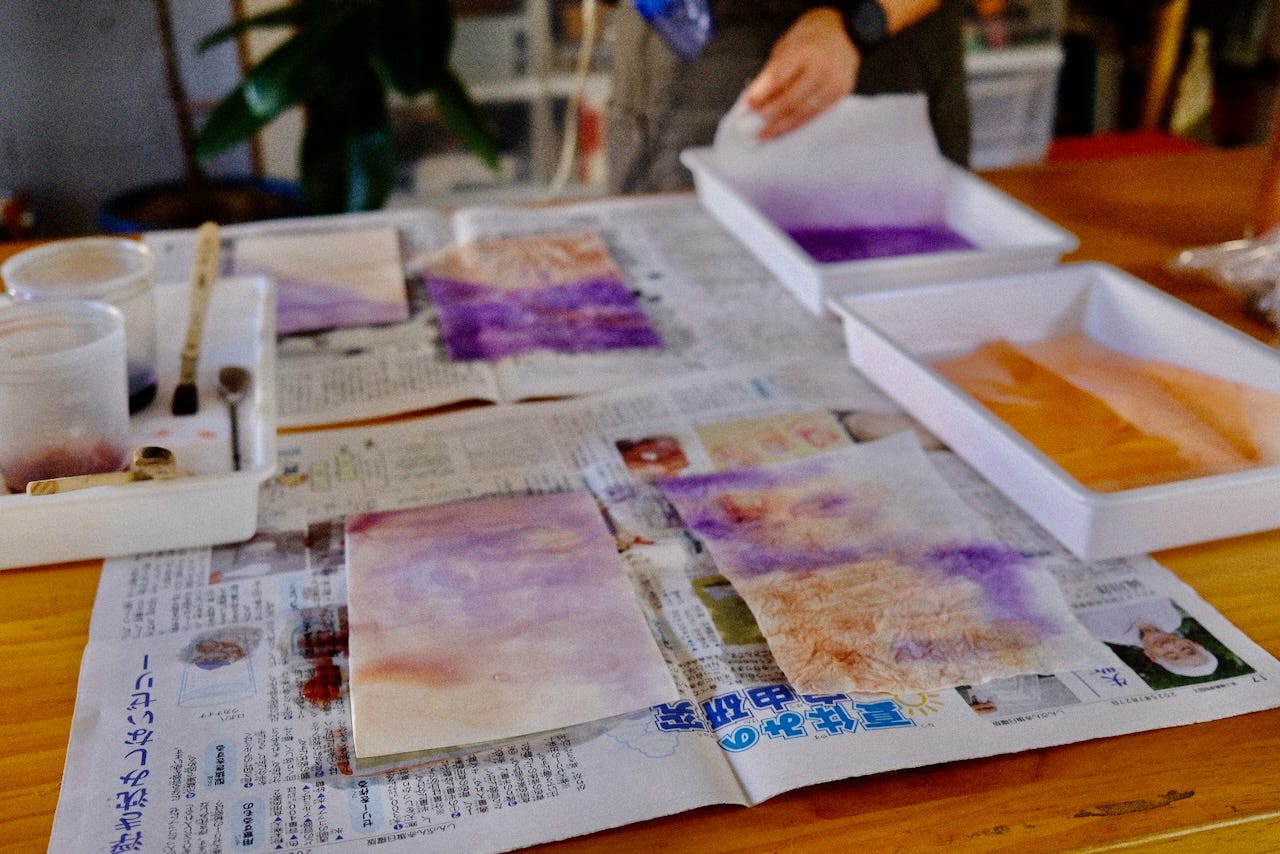
Working with nature is such an interesting process. In the recent interview story we shared at BK, Haru-chan mentions the beauty of leaning into collaboration with the natural elements of the plant-dye process rather than controlling it. The result of her work can vary depending on many factors, including temperature, humidity, and the fabric's condition. As I painted the wrinkled washi paper with vivid colors from Red Madder and Logwood, the process felt more like letting it go than painting.
As we waited for the bags to dry, we admired their presence in Haru-chan’s atelier while sipping another round of tea togther.

The particular vignette felt like it had been clipped from a photography book laid out on a coffee table… as if I were casually flipping through the book but paused for a moment because the scene was so beautiful. In the moment, I told Haru-chan, “Haru-chan, your bag is a piece of art, AND it also makes the world around it a piece of art just by being there”.

On the same night, I reached Tokyo after a very long transit. When I checked into my petite dorm-like accommodation, the first thing I did was hang the Pocket Bag I had just dyed a few hours ago. With my tired eyes, I looked at it and was assured that the vibrant aura of Haru-chan’s artifact resonated even after it traveled far from her atelier.
Thank you so much, Haru-chan, for your time and your generosity. Your art is magical, and I am so grateful that I get to introduce it to our community, one bag and one dialogue at a time.
Journey continues…